
होमKabaddiIndia vs England, Match 4: Young India Face First Test at Commonwealth Kabaddi Championship
India vs England, Match 4: Young India Face First Test at Commonwealth Kabaddi Championship
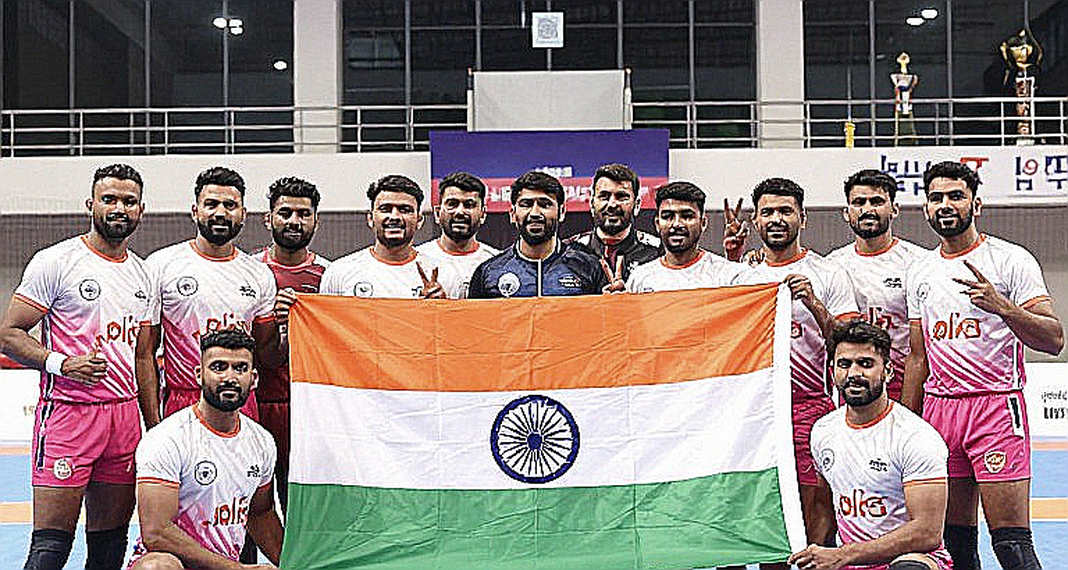
भारत और इंग्लैंड के बीच कॉमनवेल्थ कबड्डी चैंपियनशिप 2026 का चौथा मैच अहमदाबाद के एक बहु-खेल परिसर में खेला जाना है, जो भारतीय टीम का पहला मुकाबला है। टीम की कमान सुरजीत सिंह और उपकप्तानी नवीन कुमार के पास है, जबकि कई प्रमुख खिलाड़ियों को आराम देकर युवा प्रतिभाओं को मौका दिया गया है। कबड्डी 7 बनाम 7 खेल है जिसमें रेडर 30 सेकंड में विपक्षी हिस्से में जाकर टच करके लौटता है, 'कबड्डी' का लगातार उच्चारण अनिवार्य है, और बोनस लाइन से अतिरिक्त अंक मिलते हैं। ऑल आउट पर दो अंक, दो खाली रेड के बाद डू-ऑर-डाई नियम और तीन या कम खिलाड़ियों वाली रक्षा पर सुपर टैकल (2 अंक) लागू होता है। ईरान और चीनी ताइपे की गैरमौजूदगी से टूर्नामेंट का स्तर कमज़ोर है, इसलिए बड़े अंतर से जीत भी भारत की असली ताकत का प्रमाण नहीं है; स्कोरलाइन ऑल आउट और बोनस नियमों के कारण बढ़ा-चढ़ा दिखता है। भारत का असली पैमाना प्रो कबड्डी लीग और ईरान के खिलाफ पूरी ताकत वाला मुकाबला है।
The fourth match of the Commonwealth Kabaddi Championship 2026 will be played tonight at a multi-sport complex in Ahmedabad, with hosts India taking on England. This is India's first match of the tournament — not the tournament's first match. The distinction matters: a "match 4" slot implies three fixtures have already been played and that the championship is running in a round-robin or group format. For Indian kabaddi fans this is plainly the centrepiece of the day, but from a professional standpoint it is a fixture whose result is close to predetermined, and whose real significance lies not in the scoreboard but in what the selection policy reveals.
India are not fielding a full-strength side. According to available reports, the squad has been rotated, several key players rested and a large number of young talents given opportunities. That decision is itself the single most consequential piece of competitive information about this match. It means India's objective here is not to maximise margin of victory but to audit bench depth. The correct evaluation metric, therefore, is not how many points India win by, but how many new caps look ready for tournament-level kabaddi.
The side is captained by Surjeet Singh, with Naveen Kumar as vice-captain. That pairing signals a deliberate structure — senior leadership retained while the surrounding personnel are experimental. One caveat must be stated plainly: both "Surjeet Singh" and "Naveen Kumar" are common names in Indian kabaddi, and multiple players across different roles share them. No state or franchise affiliation is given in the available information, so neither player's exact role — raider or corner defender — can be fixed without further verification. That uncertainty should not be hidden in the reporting.
On the other side is England, whose men's programme is built largely on the British Punjabi diaspora. England have appeared at IKF-level international events, but their competitive ceiling sits well below Iran's and below the Asian top tier. The side is not fully professionalised, with most players operating at amateur or semi-professional level. England's realistic objective in this fixture is therefore not a result but damage limitation and technical credibility — avoiding an early cascade of All Outs.
For readers new to the sport, a quick primer is useful. Kabaddi is a 7 v 7 game on a 13m × 10m court in which offence and defence alternate. The raider must cross into the opponent's half within 30 seconds, touch at least one defender, and return to their own half for the point to count. If the defending side stops the raider inside their own half, they score a point. Throughout the raid the raider must chant "kabaddi, kabaddi" continuously; breaking the chant voids the raid. A bonus line sits deep in the opponent's half — crossing it scores a point when the defending side has six or more players on court. When every player on one side is ruled out, the opponent receives two bonus points and the entire team is revived; this is an All Out. After two consecutive empty raids, the third becomes a do-or-die raid — score or be out. A tackle completed while the defending side has three or fewer players on court is a Super Tackle, worth two points.
These rules bear directly on this match. Against a weaker opponent, the touch efficiency of Indian raiders tends to produce early All Outs, each of which carries two extra points — meaning scorelines in such fixtures systematically overstate the winner's true level. The bonus line similarly inflates individual numbers: if England field a full seven-man defence, Indian raiders can farm bonus points without taking significant risk. Anyone using this tournament to evaluate young Indian players should discount accordingly. The do-or-die rule does ensure that even in a lopsided match the raider cannot simply burn clock, so some information about individual decisiveness is available — but only against weak opposition.
Now the tournament context, and here an uncomfortable truth surfaces. According to reports, Iran and Chinese Taipei are not participating — the two sides routinely described as India's major rivals. Iran's 2026 Asian Games gold remains the landmark break in India's monopoly at world level. Their absence, along with Chinese Taipei's, materially hollows out the field. Winning here is therefore not credible evidence of India's true strength; it is a low-information achievement.
There is also an internal tension in the coverage itself. The same reporting states that India's major rivals are absent, and simultaneously that India "will need to deliver their best" and that "unexpected results are always possible". Both can be true in the abstract, but together they inflate a low-stakes fixture into a high-stakes narrative. The "Commonwealth" label also warrants caution. Kabaddi is not a Commonwealth Games sport, and a "Commonwealth Kabaddi Championship" is not an established top-tier property on the level of the Asian Games or the IKF World Cup; both its sanctioning body and its edition history are unverified. One further point: Chinese Taipei is a genuine power in women's kabaddi but not a men's heavyweight. Describing them as a major rival of the men's team suggests either a conflation with the women's game or a loose use of "rival".
None of this changes the fact that India are clear favourites — a side that has rested its stars and is still expected to win. That is in itself the strongest evidence of the sport's structural imbalance. India's talent pipeline is deep and cheap enough that a second-string team remains the favourite, a structural advantage no other kabaddi nation can replicate.
So what should viewers watch for? First, the decision-making of the young raiders — whether they avoid rash touches and look disciplined on the return. Second, the coordination of the defensive unit — the spacing between corners and covers and the collective quality of tackle attempts. Third, composure under All Out pressure, because the real test of that only comes at Asian level, not here. Fourth, rotation patterns and body language, which will reveal whom the captain trusts.
The cultural backdrop is essential. Kabaddi is effectively India's second-most-watched sports property behind cricket and functions as a genuine social-mobility route for young men from rural, low-income households — Pro Kabaddi League contracts, railway, police and army jobs are the real incentives. That is why "young talents given a chance" is not a neutral squad note but a social-mobility storyline, and Indian media will amplify it regardless of whether the numbers justify it. The host-state logic is also relevant: Gujarat is investing heavily in sports infrastructure and multi-sport event hosting, so a tournament in Ahmedabad serves a state-branding agenda as much as a kabaddi-development one.
What is entirely absent is women's kabaddi. The article discusses only the men's team, even though the women's game is Asian Games-recognised and has genuine depth in Iran and Chinese Taipei. The absence of a women's Pro Kabaddi League remains a structural gap keeping the women's game outside this commercial ecosystem.
The bottom line: this fixture is not a proof of India's strength but an audit of their depth; it is a learning opportunity for England; and the tournament is not as competitive as its name suggests. India's true benchmark remains the Pro Kabaddi League and a full-strength meeting with Iran. Tonight's audience in Ahmedabad will see a few new faces — and that is this match's real value.
संबंधित खिलाड़ी
अनुशंसित
Commonwealth Kabaddi 2026: Fourth-Placed Nigeria Hasn't Raided Once — Reading Day 1's Table2026-10-25
Jakarta 2026: Two Losses to Iran, One Tape, and the Story Nobody Filed2026-10-25
Fourteen to Thirteen: Pakistan's Line Goes Missing from the Ahmedabad Sheet, and the Questions No Press Release Answers2026-10-30
Empty Output from a Kabaddi Analysis Pipeline: When Data Exists but Information Does Not2026-10-31
The Empty Raid Is No Longer a Mistake: PKL's Most Ignored Regular-Season Weapon2026-10-30
Kabaddi: From Clay Courts to a Professional League2026-11-01
National Kabaddi Super League 2026: Bhopal Bagh Beat Coimbatore Cobra 38-34 to Clinch Title2026-11-02
अनुशंसित
Commonwealth Kabaddi Championship: India Open Campaign in Ahmedabad Against Malaysia in Women's Event and England in Men's Event2026-10-28
Costliest Raider, Cheapest Corner: A Post-Mortem of Kabaddi's Market2026-11-01
Jakarta 2026: Two Losses to Iran, One Tape, and the Story Nobody Filed2026-10-25
Kabaddi: From the Clay Court to the Global Stage2026-11-01
Under the Crore Bid, a Pay Slip: Kabaddi's Real Ledger Lives Outside the League2026-11-02
PKL auction money goes to raiders; titles go to cover defenders2026-11-03
Kabaddi Auctions Are Priced on Raid Points. They Should Be Priced on Do-or-Die.2026-10-24
Commonwealth Kabaddi Championship 2026: India's Three Wins, the 68–26 Gap, and the Team That Isn't There2026-10-29